
About Chronic Granulomatous Disease (CGD)
Suspect CGD in a patient with:
FREQUENT, RECURRENT INFECTIONS
SEVERE, UNUSUAL, AND/OR UNEXPLAINED INFECTIONS
INFECTIONS FROM A SPECIFIC GROUP OF PATHOGENS
CGD-related infections may occur at any time from infancy to late adulthood; however, most affected individuals are diagnosed before age 5.1 Approximately 1 out of every 200,000 people in the United States has CGD.2
Prevention of potentially life-threatening infections is vital for patients with CGD1-6
Potentially life-threatening infections can be difficult to manage and may require lengthy hospitalizations.
Recovery from severe infections in CGD is often complicated by3:
- Increased scar formation
- Wound dehiscence
The exaggerated inflammatory response of CGD may contribute to:
- Dysregulated cytokine production4,5
- Decreased apoptosis6
Life expectancy remains well below that of the general population3,7-10
Although survival has increased, infections are still the major causes of mortality for patients with CGD.7
Left untreated, CGD-related infections may be fatal.3,10
The survival curve of the general US population has been included for comparison.
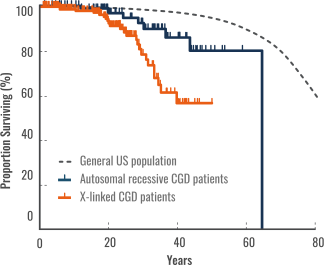
Kaplan-Meier survival curves for patients with X-linked and autosomal recessive CGD3
Understand more about the physiological processes associated with CGD
Connect your patient
with an expert
-
References:
1. Leiding JW, Holland SM. Chronic granulomatous disease. In: Pagon RA, Adam MP, Ardinger HH, et al, eds. GeneReviews®. Seattle, WA: University of Washington, Seattle; 1993-2022. 2. Winkelstein JA, Marino MC, Johnston RB, et al. Chronic granulomatous disease: report on a national registry of 368 patients. Medicine (Baltimore). 2000;79(3):155-169. 3. Kuhns DB, Alvord WG, Heller T, et al. Residual NADPH oxidase and survival in chronic granulomatous disease. N Engl J Med. 2010;363(27):2600-2610. 4. Lekstrom-Himes JA, Kuhns DB, Alvord WG, Gallin JI. Inhibition of human neutrophil IL-8 production by hydrogen peroxide and dysregulation in chronic granulomatous disease. J Immunol. 2005;174(1):411-417. 5. van de Veerdonk FL, Smeekens SP, Joosten LA, et al. Reactive oxygen species–independent activation of the IL-1β inflammasome in cells from patients with chronic granulomatous disease. Proc Natl Acad Sci U S A. 2010;107(7):3030-3033. 6. Kasahara Y, Iwai K, Yachie A, et al. Involvement of reactive oxygen intermediates in spontaneous and CD95 (Fas/APO-1)-mediated apoptosis of neutrophils. Blood. 1997;89(5):1748-1753. 7. Marciano BE, Spalding C, Fitzgerald A, et al. Common severe infections in chronic granulomatous disease. Clin Infect Dis. 2015;60(8):1176-1183. 8. Martire B, Rondelli R, Soresina A, et al. Clinical features, long-term follow-up and outcome of a large cohort of patients with chronic granulomatous disease: an Italian multicenter study. Clin Immunol. 2008;126(2):155-164. 9. Jones LBKR, McGrogan P, Flood TJ, et al. Special article: chronic granulomatous disease in the United Kingdom and Ireland: a comprehensive national patient-based registry. Clin Exp Immunol. 2008;152(2):211-218. 10. Chronic granulomatous disorder: a guide for medical professionals. CGD Society. Accessed September 16, 2019. https://cgdsociety.org/wp-content/uploads/2019/05/CGDS-Medical-Guide.pdf